Quick answer
To recreate a GTA 6 trailer shot with AI, work one shot at a time rather than prompting for a whole trailer. Every Grand Theft Auto trailer is cut from the same six beats: the aerial dusk establisher, the low-angle hero walk, the first-person night chase, the heist getaway, the coastal boat chase, and the sunset end card. Each has its own prompt structure — name the render style, lock the world, describe one camera move, state the aspect ratio, and close with negatives. Use Kling 3.0 for anything with motion, GPT Image 2 for any frame with text baked into it. Every prompt below is copy-paste ready and shown with the frame it produced.
The short version
Nobody generates a GTA trailer in one prompt. Every model caps out between 8 and 15 seconds, so a trailer is built the way a real one is: one shot at a time, then cut together.
The useful discovery is that Grand Theft Auto trailers reuse the same six beats every time. Learn those six and you can rebuild any of them — including the one dropping on August 27.
This page is about recreating Rockstar's shots. If what you want is your own face inside Vice City, that's a different guide and a much shorter one.
The six beats every GTA trailer is cut from
Watch Trailer 1 and Trailer 2 back to back with the sound off and the structure gives itself away. There's an aerial that establishes the city, a low-angle character introduction, a first-person chase, a heist, something on water, and a title card over a sunset. The order moves around. The beats don't.
Each one below is a complete prompt, the model that handles it, and the frame it actually produced.
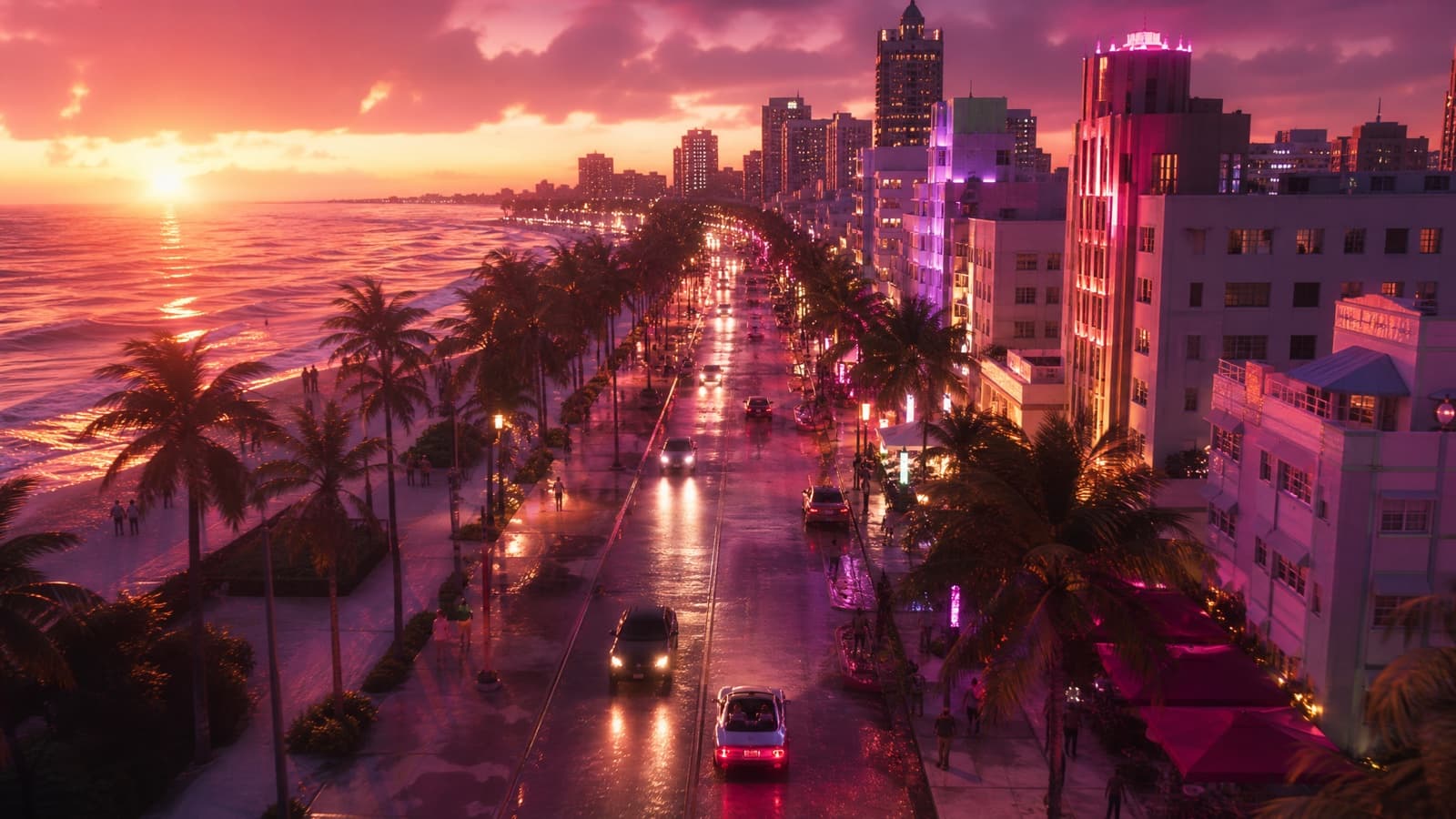
Opening establisher
Neon Dusk Drive
The shot that says city before it says anything else. It runs first in almost every GTA trailer because it does the geographic work — skyline, palms, water, weather — so nothing after it has to.
The critical instruction is slow push-in. Models default to a static drone hover, which reads as a stock aerial rather than an opening.
- Video
- 16:9
- Kling 3.0
- Veo 3.1
- Grok Imagine
Cinematic Grand Theft Auto VI style trailer shot. Slow aerial drone push-in over Vice City at golden dusk: pastel-pink sky, towering art-deco hotels, swaying palm trees, neon signs flickering on. A convertible muscle car cruises a wet beachfront boulevard, taillights smearing across the asphalt. Film grain, anamorphic lens flares, 1980s synthwave color grade in magenta and orange, shallow depth of field, photorealistic, smooth slow motion. 16:9. No on-screen text, no HUD. No real logos, no brand marks, no watermark.
Watch for: On Veo 3.1 the JSON version lands far more reliably than the prose one, and Veo starts dropping instructions past about 175 words.
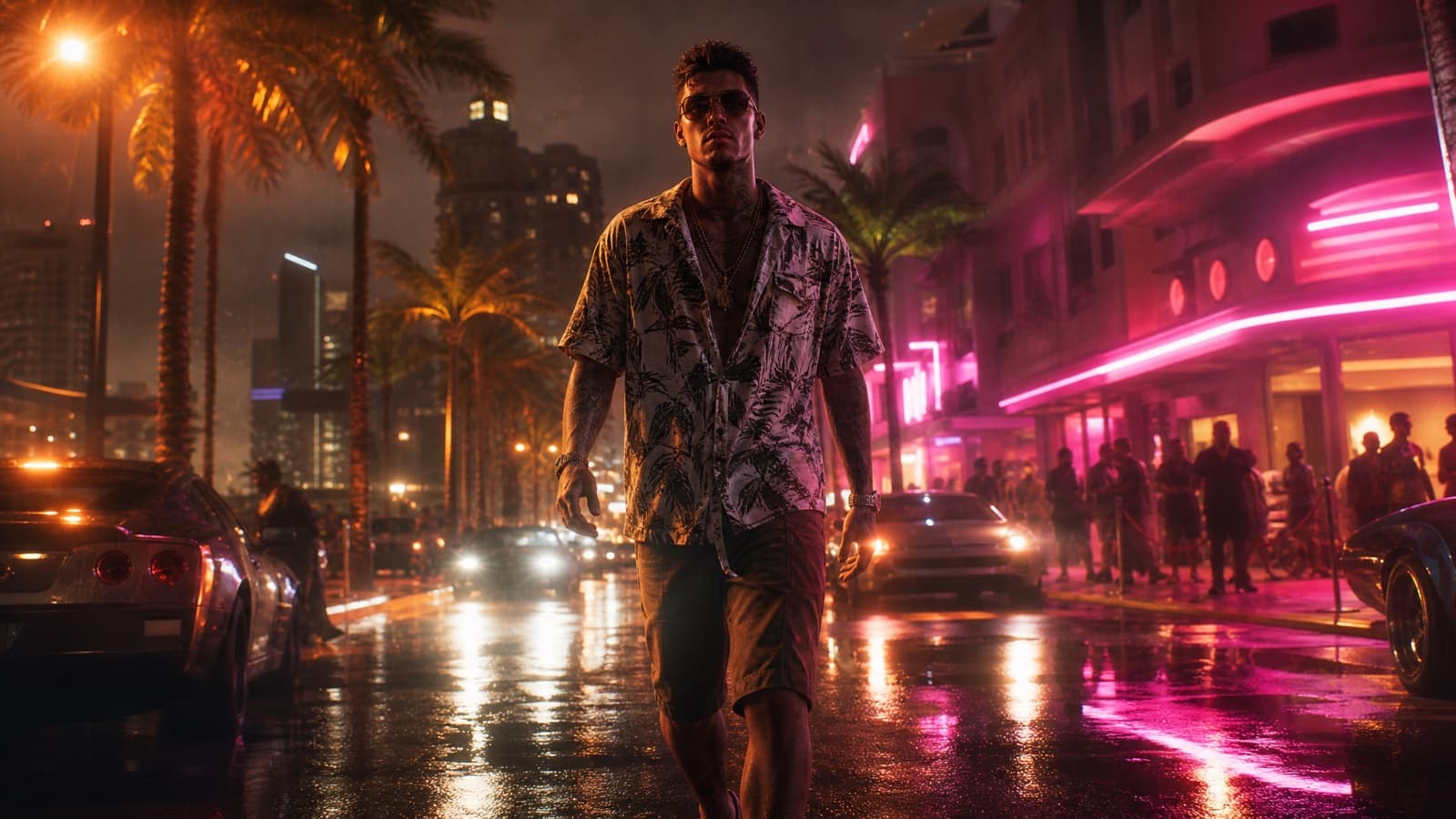
Character introduction
Slow-Mo Hero Walk
The beat that sells a protagonist. Everything is doing one job: making the subject look untouchable.
Nobody in a GTA trailer smiles during this shot, and the camera is always below eye level.
- Video
- 16:9
- Kling 3.0
- Veo 3.1
Cinematic Grand Theft Auto VI trailer intro. A confident protagonist in designer streetwear walks in slow motion toward camera down a neon-lit Vice City strip at night, gold chain glinting, palm trees and glowing club signs behind, light rain in the air. Low-angle dolly shot, dramatic backlighting, anamorphic lens flares, orange-and-pink Miami color grade, photorealistic, film grain. 16:9. No text on screen. No real logos, no brand marks, no watermark.
Watch for: Low angle is doing most of the work here. Say it explicitly — models default to eye level and the shot loses all its authority.
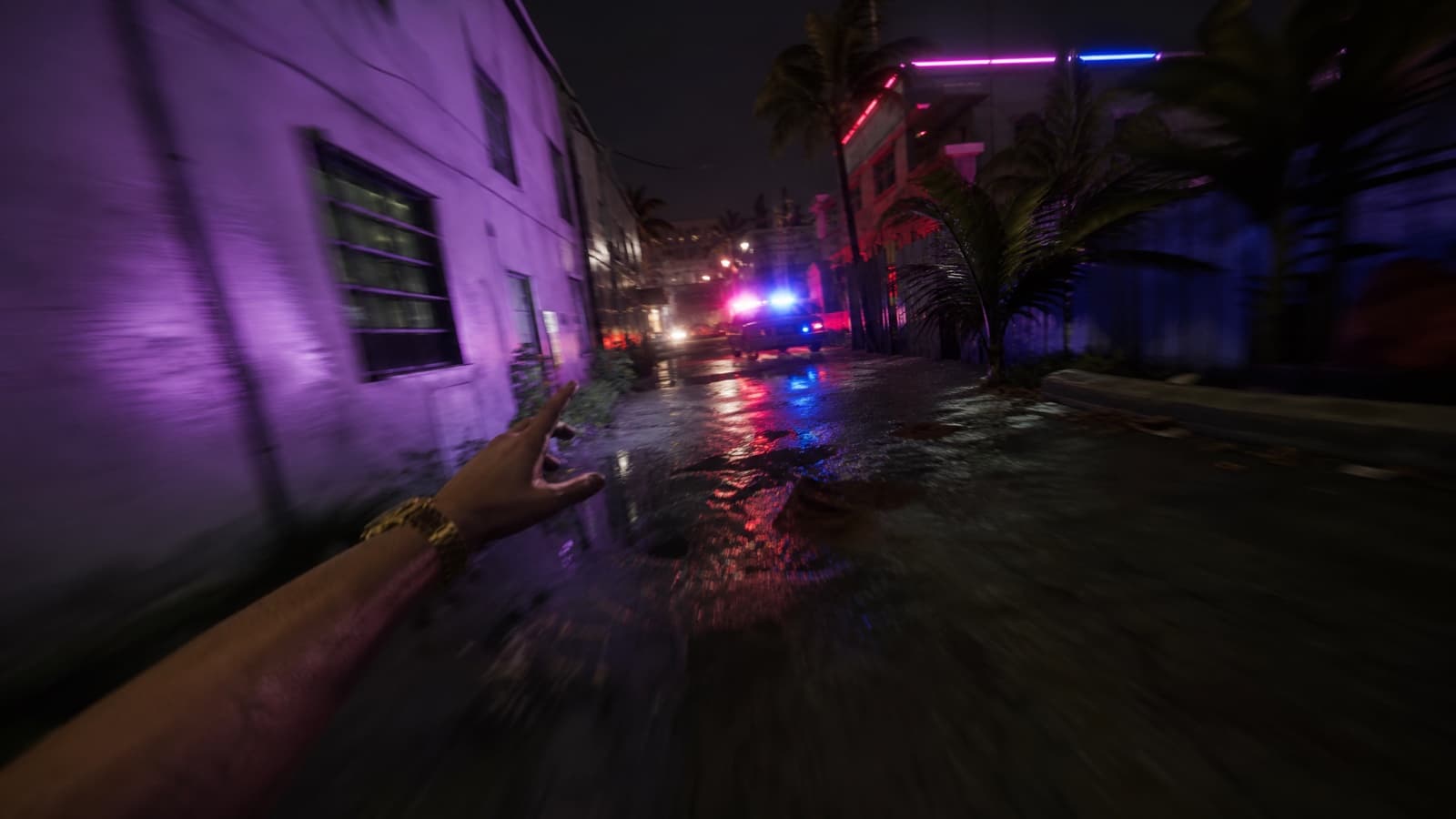
Kinetic middle
First-Person Night Chase
This is the one people mistake for gameplay, which is exactly why it's also the format behind most of the fake leak clips going around.
Handheld shake is the whole trick. Ask for it explicitly or you get a smooth glide that instantly reads as generated.
- Video
- 16:9
- Kling 3.0
- Veo 3.1
- Grok Imagine
First-person POV chase in the style of a Grand Theft Auto VI gameplay trailer. Sprinting through a rain-slicked Vice City alley at night, neon reflections on wet pavement, police lights strobing blue and red behind, palm trees and motel signs blurring past. Handheld camera shake, motion blur, cinematic teal-and-magenta grade, photorealistic, 24fps film look, tense and kinetic. 16:9. No UI overlay, no on-screen text. No real logos, no brand marks, no watermark.
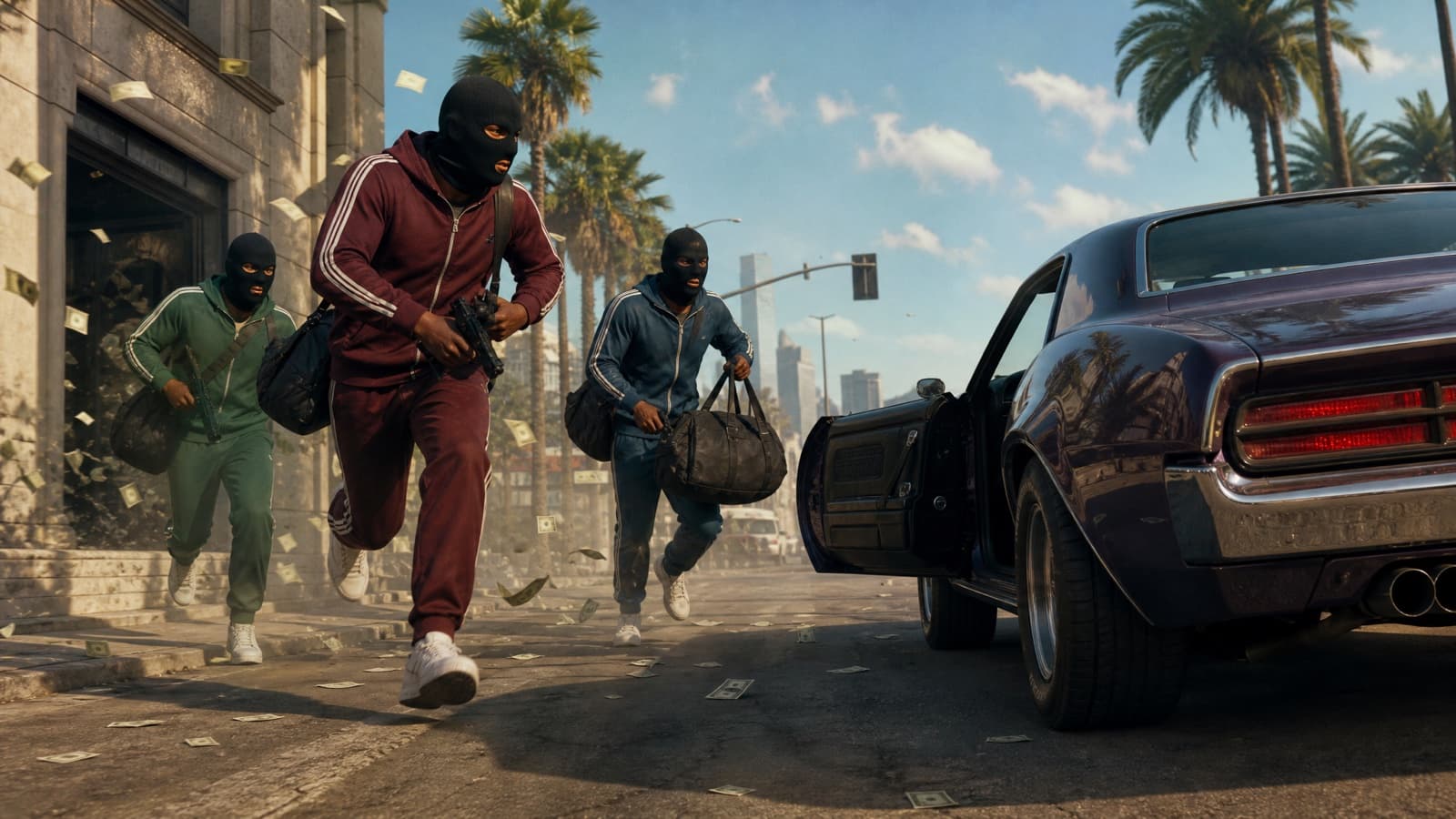
The set piece
Heist Getaway
Daylight, which is the surprise. Trailer 2 leaned hard into sun-bleached noon and it's the reason the crime beats landed differently than they did in the neon-drenched Trailer 1.
Loose banknotes in the air are doing an enormous amount of narrative work for three words of prompt.
- Video
- 16:9
- Kling 3.0
- Veo 3.1
Cinematic Grand Theft Auto VI style trailer shot. Three masked robbers in tracksuits sprint out of a bank onto a sunlit Vice City street toward a waiting muscle car with its doors open and engine running, loose banknotes tumbling through the air behind them. Handheld low tracking shot, dust and heat haze, warm high-contrast grade, photorealistic, film grain, tense and kinetic, 16:9. No on-screen text. No real logos, no brand marks, no watermark.
The change of texture
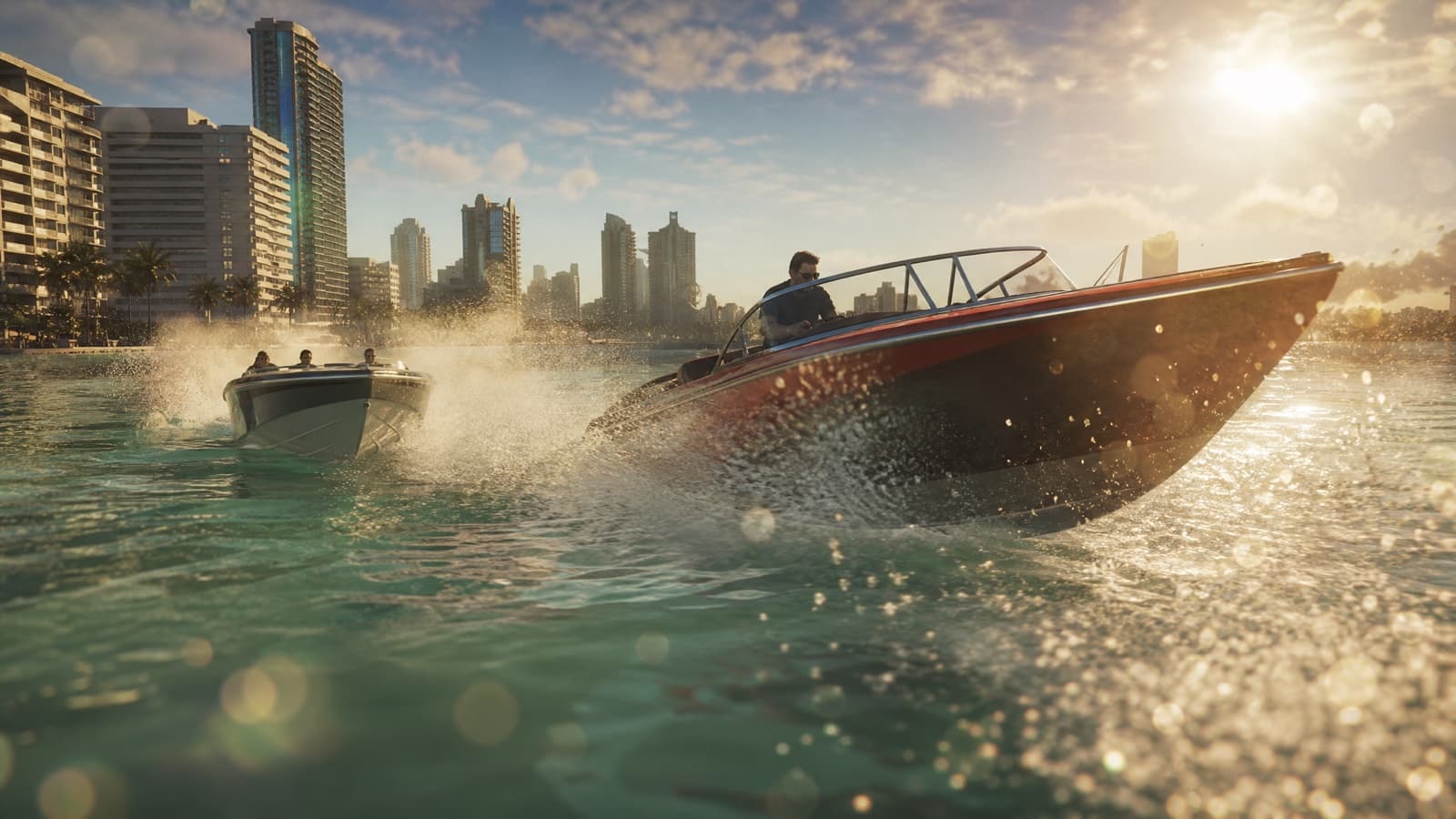
Coastal Boat Chase
Every GTA trailer breaks to water at some point, and it's the most underused setting in AI recreations. Everyone generates cars.
Keeping the camera low, just above the surface, is what separates this from a tourism advert.
- Video
- 16:9
- Kling 3.0
- Veo 3.1
- Grok Imagine
Cinematic Grand Theft Auto VI style chase. Two speedboats carve through turquoise coastal water at golden hour, throwing tall walls of spray, the Vice City skyline and its art-deco towers on the horizon behind them. Low camera skimming just above the water surface, droplets on the lens, warm backlit haze, photorealistic, film grain, smooth slow motion, 16:9. No on-screen text. No real logos, no brand marks, no watermark.
End card
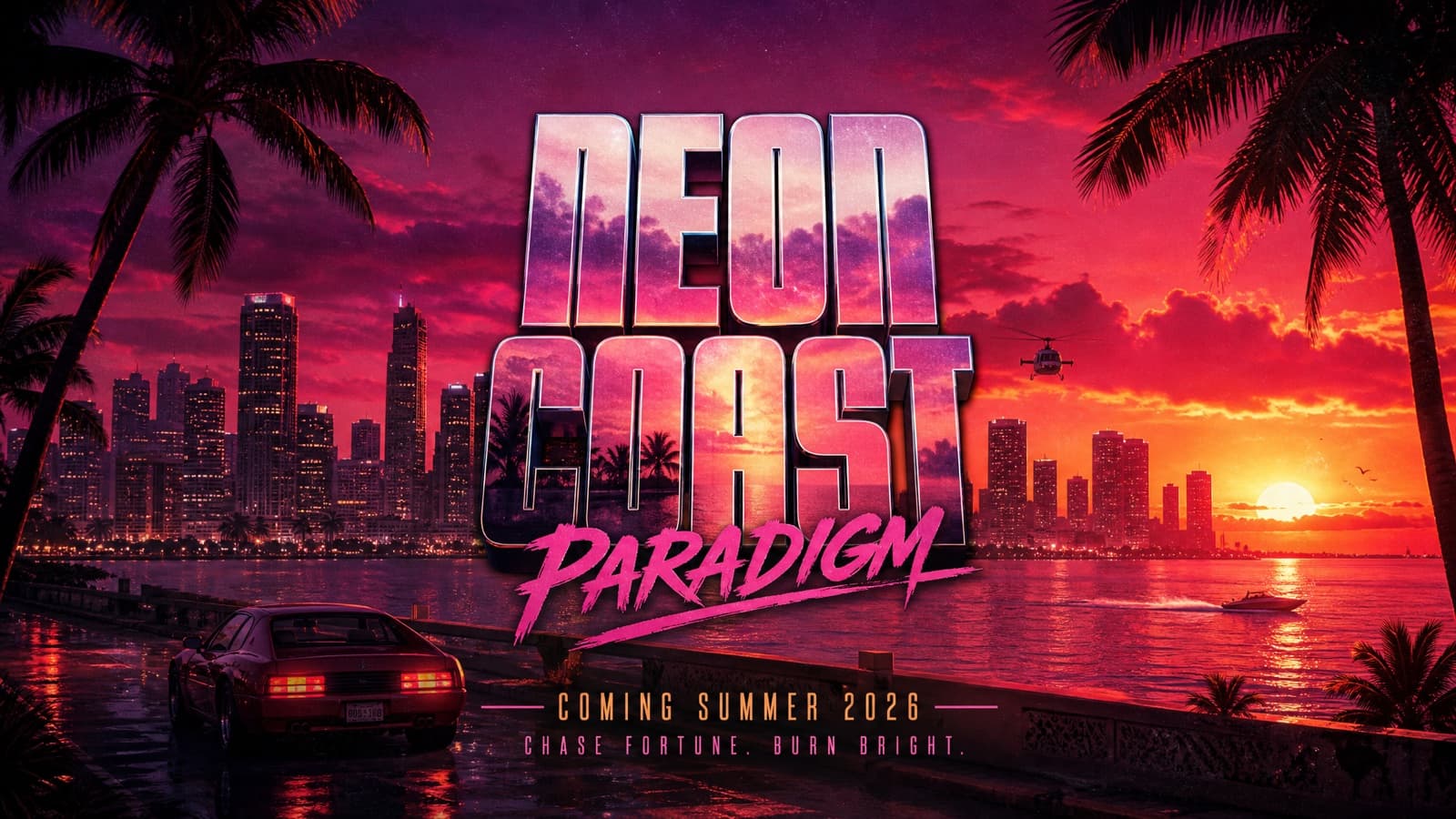
Trailer End Card
The last frame, and the only one on this list you should not generate with a video model. Baked-in text needs an image model that can actually spell.
Note the wording: an invented fictional game title. Ask for the real one and the generation gets refused.
- Still
- 16:9
- GPT Image 2
- Nano Banana Pro
A cinematic game-trailer end card in the style of Grand Theft Auto VI. A wide Vice City skyline silhouetted against a deep magenta-and-orange sunset, palm fronds framing the edges, the ocean catching the last light. Centered over it, an invented fictional game title set in a heavy condensed display typeface with a subtle chrome edge, and a small release date line beneath it. Rich film grain, glossy promotional key-art finish, 16:9. Use invented text only — no real logos, no brand marks, no watermark.
Watch for: Say invented fictional title, every time. Asking for the actual GTA wordmark is the single most common reason these generations get refused.
The grammar underneath all six
Once you've run a few, the pattern is hard to unsee. Every prompt above is the same clauses in the same order.
Cinematic Grand Theft Auto VI style trailer shot.
Leads, always. Models weight the opening clause heaviest, so the look has to come first.
Vice City at golden dusk: pastel-pink sky, towering art-deco hotels, swaying palm trees, neon signs flickering on.
Lock the place and the hour. "GTA style" on its own gets you generic crime-movie sludge.
Slow aerial drone push-in, anamorphic wide lens.
Exactly one move. Two camera instructions in a single shot is the most common reason a generation comes out incoherent.
Smooth slow motion, film grain, shallow depth of field, 1980s synthwave grade in magenta and orange.
The finish. This is what separates a trailer frame from a screenshot.
Then close every prompt with the format and the negatives: '16:9. No on-screen text, no HUD, no real logos, no brand marks, no watermark.' Neither is optional — the first because no model defaults to 16:9, the second because of what it prevents.
The clause people skip is the camera move, and it's the one that matters most. "Cinematic Vice City at night" gives you a postcard. "Low-angle dolly shot pushing in on a figure walking down a neon-lit strip at night" gives you a trailer frame.
Which model for which shot
| Shot type | Model | Why |
|---|---|---|
| Anything with motion | Kling 3.0 | Native multi-shot up to 15 seconds. The only one that handles a cut inside a single generation. |
| One hero shot, maximum quality | Veo 3.1 | 4K with synced audio, but an 8-second ceiling. Feed it the JSON variant, not the prose. |
| Any frame with text in it | GPT Image 2 | End cards, mission titles, wanted posters. Video models still garble small type. |
| Your face across every cut | Seedance 2.0 | The only one that holds one identity through multiple shots without drift. |
| Fast and disposable | Grok Imagine | 6 to 15 seconds with audio. Meme-tier quality, meme-tier effort. |
On Veo 3.1 specifically, the JSON variant of a prompt outperforms the prose one by a wide margin — toggle any prompt above to JSON to see the shape. Veo also starts dropping instructions past roughly 175 words, so trim the world clause before you trim the camera clause.
The one thing that gets you refused
It is almost never the violence, the police, or the heist. It's the trademark.
Asking for the GTA logo, the Rockstar wordmark, or a named car manufacturer trips the copyright filter. Asking for the look does not. Every prompt on this page ends with No real logos, no brand marks, no watermark for exactly this reason, and every one of them renders.
Swap "the GTA VI logo" for "an invented fictional game title," and "a Lamborghini" for "a wedge-shaped 1980s supercar." Same frame, no refusal.
Cutting them together
Six generations at 8 to 15 seconds each gives you roughly 70 seconds of footage, which is more than enough — real trailers cut most shots at two to three seconds.
Three things that make the difference between a reel of clips and something that reads as a trailer:
- Grade them to match. Generations drift in color even from near-identical prompts. One pass of the same LUT across all six is what makes them feel shot by one camera.
- Cut on the beat, not on the action. GTA trailers are edited to music, and the cuts land on the downbeat regardless of what's happening in frame.
- Hold the end card twice as long as feels right. Every trailer does. It's where the release date sits.
When the Extended Look drops
Grand Theft Auto VI: An Extended Look premieres Thursday, August 27, 2026 at 3:00pm ET on Netflix, and free on the Rockstar Games YouTube channel at 9:00pm ET the same evening. Full timings are in the trailer guide.
This page gets a shot-by-shot breakdown of that trailer once it airs — every new beat, with a matching prompt and a reference frame, in the same format as the six above. If Rockstar introduces a shot the existing six don't cover, it gets added to the list rather than replacing it.
Or skip the six generations
Everything above assumes you want Rockstar's shots. If what you actually want is you in them, prompting shot-by-shot is the wrong tool — the hard part isn't any single frame, it's keeping one face recognizable across six of them.
The same structure this page breaks down, cut automatically. One uploaded photo, fifteen seconds, face consistent across every cut.
Make thisGTA 6 Trailer
Upload one selfie and get a cinematic 15-second Vice City trailer starring you — the drive, the crew, the heist, the getaway.
Keep going
- All 38 GTA 6 AI prompts — the full library, every prompt with its render
- When is the GTA 6 Netflix trailer? — August 27 timings in every zone
- Is the GTA 6 leak real? — telling real leaked footage from AI fakes
- GTA 6 prompts for ChatGPT — and why ChatGPT refuses most of them
- Turn your photo into a GTA 6 character — nine styles, real before-and-afters
Every prompt on this page was run on the model named beside it; the frames shown are unretouched output. Not affiliated with or endorsed by Rockstar Games. All prompts and templates referenced are fan-made parody in the style of Grand Theft Auto VI, and none request or reproduce Rockstar trademarks.