Quick answer
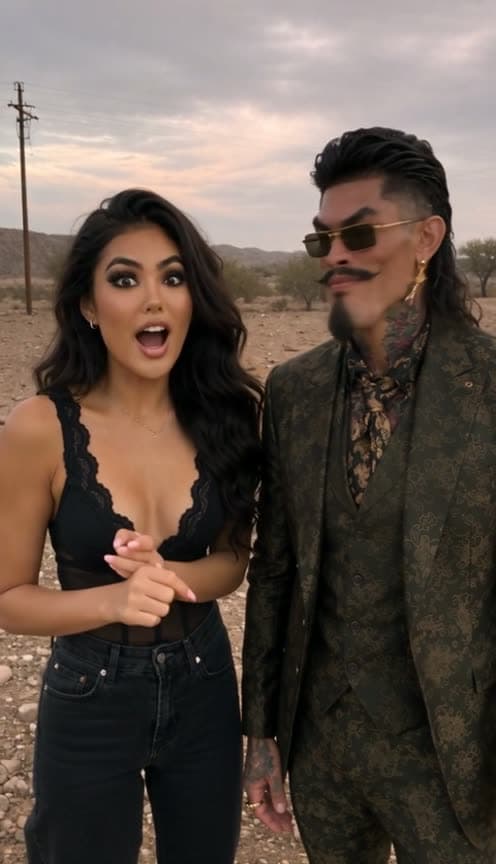
Starrd's Every Time Working, No Stopping template recreates the viral desert chat from two photos. Photo 1 stands on the left and asks "Are you married now?" and "How many kids do you have?" Photo 2 stands on the right, calmly answers "Eleven.", and when photo 1 asks "You have eleven kids?" explains with a straight face and a wide sweep of the arm: "I am every time working, no stopping." Both of you crack up. The clip is rebuilt as one handheld phone take in a rocky desert at dusk, with both people lip-syncing the original audio and keeping their own look. 21 seconds, vertical 9:16, Seedance 2.5, 250 credits (about $12.50).
Two photos in, and out comes you and a friend recreating the viral "every time working, no stopping" desert chat: one of you asks the polite questions, the other admits to eleven kids and explains how, with a completely straight face. One handheld take, every line lip-synced. Here it is:
Every Time Working, No Stopping
Two photos. One of you asks how many kids, the other says eleven and explains why. The 21-second desert chat, lip-synced.
What You Get
- The whole conversation. All three questions, all three answers and both rounds of laughter, 21 seconds from "Are you married now?" to the end.
- Two people, two roles. Photo 1 asks from the left, photo 2 answers from the right, and nobody ever swaps.
- Real lip sync. Both of you mouth your own lines to the original audio, and the listener's mouth stays still while the other one talks.
- The performances. The asker's cheeky giggle, the eyebrows shooting up at "eleven" and the doubled-over laugh; the answerer's calm, proud half-smile, the matter-of-fact "Eleven." and the wide sweep of the arm on the punchline.
- The original camera. One unbroken handheld phone shot that drifts, bobs and tips up at the sky as the person filming laughs.
- 21 seconds, vertical 9:16, ready for TikTok, Reels and Shorts.
What the Video Actually Is
The clip was posted on TikTok on June 28, 2023 by the creator J O N A T H A N (@________jonathan____), captioned "Everytime working no stopping!!! 😂 😂 😂 this guys hilarious!!!". It has 72,000+ plays and 2,000+ shares. It's a square phone video of two people standing side by side in a rocky desert at dusk, with a dusty pickup and a power pole behind them and a friend behind the camera who can't stop laughing.
The joke is how unbothered he is. "Eleven." arrives with no pause and no apology, she checks she heard it right, and his explanation is so simple and so proud that neither of them can hold it together.
Why it suits AI: the whole thing is two faces and perfect timing. Two photos let you and a friend play it straight, without driving out to the desert.
The Script, Beat by Beat
| Time | Who | Line |
|---|---|---|
| 0:00 | Photo 1, giggling | "Are you married now?" |
| 0.9s | Photo 2, calm | "Yeah, I'm married." |
| 1.7s | Photo 1 | "How many kids do you have?" |
| 3.2s | Photo 2, matter-of-fact | "Eleven." |
| 4.1s | Photo 1, eyebrows up | "You have eleven kids?" |
| 5.7s | Both | burst out laughing; photo 1 doubles over at 7.2s |
| 11.5s | Photo 2, straight face, sweeping one arm out wide | "I am every time working, no stopping." |
| 14.8s | Both | crack up again, to the end at 21s |
Who plays who: photo 1 asks, photo 2 has the eleven kids. Put the friend with the best deadpan second.
Your Look, Their Desert
- Your own face, hair and clothes. Nobody gets the original's headscarf, robe or long hair.
- Your own glasses. If your photo has sunglasses, you keep them on; if it doesn't, you don't get any.
- Their desert. Both of you stand on red-brown gravel with low thorn trees, rocky hills, a wooden power pole and a dusty dark-red pickup behind you, under a soft pink evening sky.
Use clear photos where you're looking roughly at the camera, ideally showing most of your outfit: it's a waist-up two-shot the whole way through. If you and your friend are dressed alike, that's fine: the template tells the two of you apart by hairstyle as well as clothes.
The Fastest Way
Every Time Working, No Stopping
Two photos, the full 21-second desert chat with the original audio, every line lip-synced.
Two photos, 250 credits (about $12.50), no prompt. It renders on Seedance 2.5 at 480p, vertical 9:16.
Build It Yourself
1. Turn the clip into a depth map. Run the clip through a depth-estimation model (Depth Anything V2 works). The original is square, so keep the depth video square and let the video model reframe it to vertical.
2. Scrub everything that belongs to the original people. His checkered headscarf comes through the depth map as a clear outline, so smooth it down to a plain dome. Her long hair needs the same treatment, but only on her side of the frame: a "hair" mask from a segmentation model (CLIPSeg works) also grabs his beard, and flattening the beard ruins his lip sync. Cut her face out of the mask too, so her mouth keeps its shape.
3. Make one storyboard sheet of the moments that last. Six two-shot panels: the first question, the second question, the disbelief at "eleven", the first big laugh, the arm sweep and the final laugh. Generate them all from the two photos in one desert.
A medium two-shot from the waist up in a rocky desert at dusk, the camera a little closer: the person from reference image 2 on the right sweeps one arm out wide across the frame in front of the person from reference image 1, explaining with a straight face, the eyebrows raised, the mouth open mid-word; the person from reference image 1 on the left, the hands at the waist, grinning and trying not to laugh. Red-brown gravel, low round thorn trees, a wooden power pole and a dusty dark-red pickup behind them, a soft overcast sky with a pink glow. A real, unpolished phone video look. No text.
4. Drive it with the depth map and the conversation. Put the original audio inside the depth video, so both mouths have something to match. Feed the sheet, both photos and the depth video to a model that copies motion from a reference video (we recommend Seedance 2.5). Then write three things it can't get from a depth map:
- A timed beat list: who says what, and when, through the one unbroken take.
- The speaking windows: exactly when each person's mouth moves, and that the listener's stays still.
- The faces: the asker's cheeky giggle and wide-eyed disbelief; the answerer's calm pride, the straight-faced punchline and the laugh with the eyes squeezed shut.
Lay the full original audio back on at the end.
Common Mistakes
Giving a split-second shot its own storyboard panel. The original opens with a half-second close-up before the two-shot. We first drew that close-up as its own panel, and the model held it as a frozen still for almost two seconds. Start on the two-shot and keep every panel to a moment that lasts.
Trusting the transcript's first timestamp. Speech recognition stretched "Are" back nearly a second before she actually starts talking. Re-run it on the trimmed audio before you time the mouths.
Putting a hair mask over the beard. The hair dome flattens his jaw, and his mouth stops moving. Keep it on her side of the frame.
Driving with the raw clip. The headscarf, robe and long hair come straight through. Use the depth map.
Leaving the sides to chance. Say who stands on the left and who on the right in every beat, or the two of you swap places halfway through.
FAQ
How many photos? Exactly two: the one asking and the one with eleven kids.
Is it the full clip? It's the whole conversation, from "Are you married now?" to the last laugh, 21 seconds.
How long is it? 21 seconds, vertical 9:16.
What does it cost? 250 credits, about $12.50.
Related Reading
- How to Make the 'Put a Mind Chip' AI Interview Meme: another deadpan two-person interview, lip-synced
- How to Make the 'Like 700 MPH' AI Interview Meme: the boardroom interview with the unbelievable answer
- How to Make the 'Deep Down In My Heart' AI Video: the crying-interview meme, starring you and a friend
- Viral AI Video Trends 2026: every trend we've turned into a template this year