Quick answer
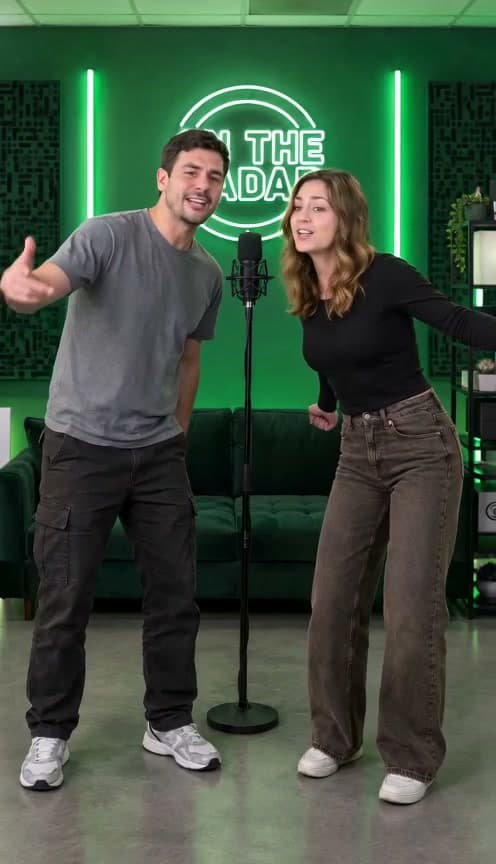
Upload two photos to Starrd's On The Radar template and it puts both of you in the On The Radar booth — side by side at the mic, under the green neon sign, trading the '679' hook. It costs 100 credits (about $5), takes two photos, and comes out vertical 9:16 at 14 seconds with the real track underneath.
The same dance, any subject — tap one to make it with your photo.
Two photos in, and out comes you and whoever on the On The Radar mic — green neon behind you, one locked vertical shot, trading the hook. Here's exactly what you get:
On The Radar
Two photos, one radio booth. You and whoever, on the same mic — green neon, real track underneath. No prompt to write.
What the Sound Is
"679" by Fetty Wap featuring Remy Boyz — released 29 June 2015, from his self-titled debut album. It went to No. 4 on the Billboard Hot 100, his second-highest-charting single behind "Trap Queen".
The bit everyone uses is the hook — yeah she's fine, wonderin' when she'll be mine. Search behaviour follows it too: people look up that line far more often than they look up the track number, which is worth knowing if you're writing captions.
What On The Radar Actually Is
On The Radar Radio, launched in 2018 by Gabe P. He'd interned at Power 105.1 under Angie Martinez while at St. John's University, and the first episodes were shot in what he's described as a closet.
The set never got much bigger, and that's the point:
- one flat wall lit hard green
- the neon ON THE RADAR sign in a circular badge
- a condenser mic on a straight stand
- a couch, some shelves with merch
- filmed vertical, locked off, one take
That's the entire visual language. Around 885,000 YouTube subscribers and 1,400+ freestyles later, it's one of the most recognisable backdrops in rap — the Drake and Central Cee "On The Radar Freestyle" was the breakout, and Gabe P's first Hot 100 credit.
Is This Still a Trend?
Yes, and it's a strange one: the song is eleven years old and there's no new release driving it.
What's driving it is how easy the set is to fake. One flat wall, one sign, one mic, no camera movement — a video model can rebuild that convincingly in a way it cannot rebuild a concert, a car or a crowd. So creators made it the default backdrop for AI rap edits, and "679" became the default sound.
The tell is in what people search. Nearly every query carries tutorial, how to, free or template — this is a trend people are actively trying to make, not just watch. TikTok has standing pages for AI On The Radar Trend, Fetty Wap On The Radar AI Tutorial, On The Radar Freestyle AI Tutorial and How to Make an AI On The Radar Video.
Why It's Vertical, Not Widescreen
Because the original is vertical. That's unusual — most music-video trends are widescreen and lose something when they're cropped for TikTok. This one was born in a portrait frame.
A single locked-off vertical shot with the artist centred and the sign glowing behind them is the format. Render it 16:9 and you've made a generic studio clip that happens to have a green wall in it.
The Fastest Way
On The Radar
Two photos. You and whoever in the On The Radar booth, trading the 679 hook. 14 seconds, vertical, real audio.
Upload two photos, one person each. You get back a 14-second vertical clip with the real track on it. No prompt, no CapCut, no green screen in your living room.
Build It Yourself
If you'd rather assemble it by hand, here's the shape of it.
1. Build the booth still first. Don't animate your raw selfies. Generate a still of both people already standing in the room, then animate that:
A photorealistic VERTICAL 9:16 studio photograph of the TWO subjects from the reference photos performing together in a radio studio.LEFT subject: the first subject from the reference photos, standing TALL and FULLY UPRIGHT, arms raised and clearly separated from the body at about chest height, as if gesturing while rapping.RIGHT subject: the second subject from the reference photos, standing TALL and FULLY UPRIGHT on both feet, arms down and clearly separated from the torso.PRESERVE the exact identity of each subject — face, hair, skin tone and clothing — exactly as in their reference photo. Do NOT blend the two subjects together and do NOT swap their clothing.They stand side by side with a clear gap of empty floor between them, neither overlapping nor touching. BOTH are shown FULL BODY from head to feet, feet flat on the floor, filling most of the frame height.SETTING: a radio studio. Behind them a wall washed in deep green light carries a single large glowing white neon sign reading "ON THE RADAR" inside a circular badge, with tall vertical green neon tubes either side. A low dark green sofa sits against the wall and a shelving unit stands at the right edge. A single black condenser microphone on a slim boom stand rises between the two subjects. Smooth grey floor.Photorealistic, sharp focus. Vertical 9:16 portrait orientation. No text other than the neon sign itself, no logos, no watermarks, no other people.
2. Drive it with a performance clip. Take that still into a video model that accepts both an image reference and a video reference, and hand it a clip of the performance you want copied. Every gesture, every head movement, every beat comes from the driving clip — not from your prompt.
3. Lock left to left and right to right. With two characters you have to say which copies which, explicitly, or the model will average them into the same moves. One line does it: the character on the left of the still copies the left performer, the character on the right copies the right performer.
4. Do not describe the moves. This is the counterintuitive one. Writing bobbing on the beat or gesturing with their hands makes the output worse — the model satisfies your description with the smallest possible version of it and throws away the real choreography from the clip. Say only that the moves are copied exactly, and let the clip supply them.
Same goes for framing. Adding "full body", "feet on the floor" or "static locked-off camera" to the video prompt measurably suppresses the movement. Put that language in the still prompt instead, where it belongs, and keep the video prompt about nothing but the performance.
5. Put the real track on afterward. Render silent and lay "679" over the top. A video model's generated audio on a song this well known is instantly obvious.
Common Mistakes
Cropping it widescreen. The format is vertical. Wide, it's just a green room.
Uploading one group photo for both slots. Two photos, one person in each. Hand it a group shot and the model has to guess who's who.
Describing the choreography. Covered above, and it's the single biggest quality killer on two-person templates.
Forgetting the left/right lock. Without it both characters do the same thing at the same time and it reads as a filter, not a performance.
Letting the model generate the audio. Everybody knows this hook. A near-miss is worse than silence.
FAQ
What is the On The Radar trend? Putting yourself into the On The Radar booth — green wall, neon sign, mic on a stand — performing to camera in one vertical take, usually over "679".
What song is it? "679" by Fetty Wap featuring Remy Boyz, released 29 June 2015. It peaked at No. 4 on the Hot 100.
Who runs On The Radar? Gabe P, who started it in 2018 and filmed the early episodes in a closet.
Why vertical? Because the original is. It's one of the few trends that was born in a portrait frame.
Why two photos? The performance has two people trading the hook, and each is mapped separately. Most CapCut versions can only swap one face.
How much? 100 credits, about $5. Credits never expire.