Quick answer
Upload one photo to Starrd's Show You Off template and it puts you in the 'Beauty and a Beat' pool party — holding the camera yourself at arm's length on a wide fisheye lens, singing into it while dancers move behind you, in one unbroken shot. It costs 100 credits (about $5), takes a single photo, and comes out widescreen 16:9 at 12 seconds with the real track underneath.
The same dance, any subject — tap one to make it with your photo.
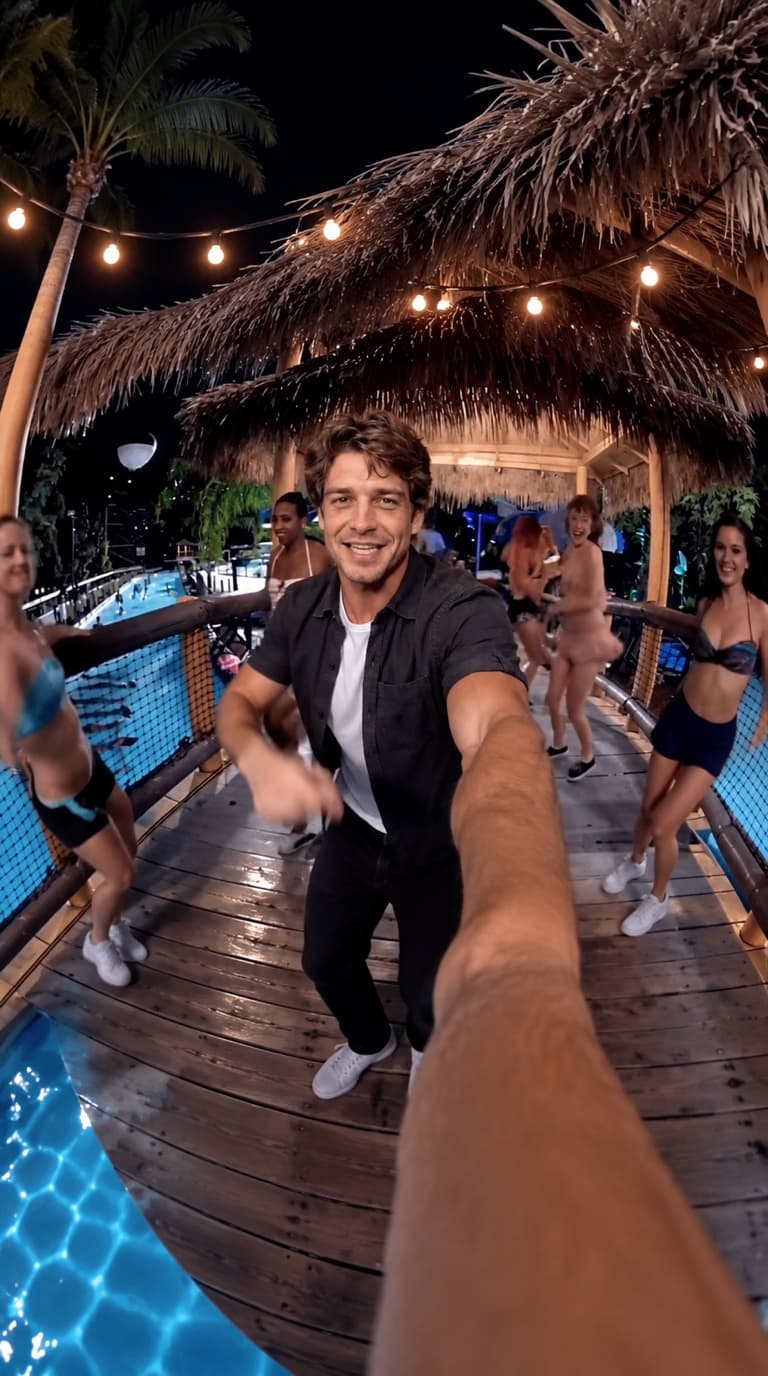
One photo in, and out comes you holding the camera at the pool party — arm stretched into frame, fisheye curve on everything, dancers behind you, one unbroken shot. Here's exactly what you get:
Show You Off
One photo. You're the one holding the camera at the pool party — fisheye selfie, dancers behind you, real track underneath. No prompt to write.
What the Sound Is
"Beauty and a Beat" by Justin Bieber featuring Nicki Minaj — from the 2012 album Believe, produced by Max Martin and Zedd. The single came out on 24 October 2012; the video dropped a fortnight earlier, on 12 October.
The hook line is "show you off," and that's the phrase the trend actually travels under. People search show you off far more than they search the song title, which is why the template is named after the lyric rather than the record.
Is This Still a Trend?
Very much so — and it's a revival, not a leftover.
Bieber's Coachella 2026 set leaned hard on the early catalogue, and "Beauty and a Beat" went off like it was new. In the week after:
- 10.3 million streams, up 317% week over week
- No. 3 on Spotify's global chart
- Back on the Billboard Hot 100 at No. 26 — its first chart appearance since the original run, when it peaked at No. 5
- No. 1 in Switzerland on 26 April 2026
Twenty-one of his songs landed in Spotify's Global Top 200 off that one set, and his catalogue cleared 77 million streams in a single day. The video itself has passed 1.3 billion views.
The sound is doing the work, but the shot is what makes a clip recognisable. Plenty of people are posting edits over this audio; far fewer are recreating the actual fisheye selfie look, which is why it still stands out in a feed.
What the Original Video Actually Is
Worth knowing, because it explains every decision the template makes.
The "Beauty and a Beat" video was co-directed by Bieber and Jon M. Chu, and filmed at Raging Waters in San Dimas, California. The conceit was that it was personal footage stolen from Bieber and leaked by an anonymous blogger — so it's staged to look like amateur camera-roll video, not a production.
Most of it was shot on a GoPro Hero 2, held at arm's length, in long continuous takes: Bieber walking backwards through a water park party, singing into the lens, dancers filling the deck behind him, Nicki Minaj rapping from the pool.
That's the whole look. Wide lens, curved horizon, your own forearm filling the bottom of the frame, no cuts.
The Fastest Way
One photo, one tap.
Show You Off
Drop one photo and you land in the pool party holding the camera yourself. 12 seconds, widescreen 16:9, 100 credits.
What comes back: you at the centre of a night-time poolside party — wooden deck, lit turquoise pool, thatched cabana, string bulb lights, dancers moving behind you — holding the camera at arm's length and singing into it, the whole thing bent by a wide fisheye. 12 seconds, widescreen, the real track underneath.
Why It's Widescreen, Not Vertical
Almost every trend template is vertical. This one isn't, deliberately.
A GoPro held at arm's length gives you a wide frame with heavy barrel distortion — the horizon bends, your forearm goes huge in the foreground, and the party spreads across the full width behind you. Crop that to 9:16 and you throw away the distortion and most of the crowd, and what's left is just a person filming themselves.
The widescreen frame is the reference. Post it as-is; it reads instantly.
Build It Yourself
If you'd rather assemble it by hand instead of using the template, here's the shape of it.
1. Put yourself in the scene first. Don't try to animate your raw selfie. Generate a still of you already inside the party, in the right lens and the right framing, then animate that:
A photorealistic WIDE 16:9 LANDSCAPE photograph shot on a wide fisheye action camera held at arm's length — a selfie point of view.THE SUBJECT: the person from the reference photo, holding the camera themselves. Their own arm reaches up from the bottom of the frame toward the lens, forearm large and close in the foreground and slightly curved by the fisheye. Their head and upper body are centered, looking straight into the lens with a wide open smile, mid-laugh, as if singing along.PRESERVE the exact identity of the subject — face, hair, facial hair, skin tone, build and the clothing they are actually wearing in the reference photo. Only the pose and the setting change. Do NOT restyle them, do NOT change their outfit, do NOT add sunglasses, hats or accessories they are not already wearing.SETTING: a night-time poolside tiki party. A wooden deck runs away from the camera, a lit swimming pool glowing turquoise along one side, a thatched palm-roof cabana overhead, palm trees, and warm string bulb lights criss-crossing the top of the frame. Several young people in summer clothes and swimwear dance on the deck behind the subject, spread across the full width of the wide frame, slightly motion-blurred.Wide-angle fisheye barrel distortion with a curved horizon, warm practical lighting against a dark night sky. Photorealistic, sharp focus on the subject's face. Horizontal 16:9 landscape orientation, filling the full width. Exactly ONE main subject. No text, no captions, no logos, no watermarks.
2. Drive it with a performance clip. Take that still into a video model that accepts both an image reference and a video reference, and hand it a clip of the camera move you want copied. The walk-and-sing timing, the head bob, the lean-in — all of that comes from the driving clip, not from your prompt. This is the part people skip, and it's why their version looks like a static portrait with a wobble on it.
3. Say the shot out loud in the prompt. Selfie point of view, arm in the lower foreground, fisheye barrel distortion, one continuous shot, no cuts. Video models will happily cut away to a third-person angle if you don't forbid it, and the moment it does that, the illusion is gone.
4. Pick the right model. You want video-to-video with real identity preservation — the face has to survive twelve seconds of motion and lens distortion without drifting into someone else. We use Seedance 2.0 for this.
If your subject's face slowly turns into a different person over the clip, that's identity drift, not a prompt problem. Feed a cleaner, better-lit, more front-on source photo before you rewrite anything.
5. Put the real track on afterward. Render silent and lay the actual song over the top. A video model's attempt at generating music will always sound worse than the record, and on a song this recognisable the gap is brutal.
Common Mistakes
Cropping it vertical. Covered above, but it's the number one thing that kills the look. The fisheye stretch needs the width.
Using a photo with sunglasses. The whole shot is your face, close, centred, for twelve straight seconds. Anything covering it gives the model less to hold onto and the identity wanders.
A group photo. One subject. The crowd behind you is generated — if you upload two people, the model has to decide which one is holding the camera, and it won't always pick the one you meant.
Asking for a "music video." Too broad. You're recreating one specific shot: a handheld selfie walk-through. Describe the shot, not the genre.
Letting the model generate the audio. It sounds like a knockoff of a song everybody already knows by heart.
FAQ
What is the Show You Off trend? Recreating the "Beauty and a Beat" video shot — a GoPro held at arm's length, walking backwards through a pool party, singing into a wide fisheye lens.
What song is it? "Beauty and a Beat" by Justin Bieber featuring Nicki Minaj, produced by Max Martin and Zedd, released 24 October 2012.
Why now? Bieber's Coachella 2026 set pushed it back onto the Billboard Hot 100 at No. 26 and to No. 3 on Spotify's global chart.
Why widescreen? Because the original is a wide GoPro selfie. Vertical throws away the fisheye distortion and the crowd.
How much? 100 credits, about $5. Credits never expire.